
Equity markets will be driven by the outcome of the US Federal Reserve's interest rate decision this week, analysts said. Moreover, equity benchmarks will also continue to be guided by foreign fund movement and trend in Brent crude oil, they added. "The global markets are looking nervous after the US inflation numbers, which have caused the dollar index to hover around 110," said Santosh Meena, head of research, Swastika Investmart Ltd. Now everyone is eyeing the outcome of the upcoming US Federal Open Market Committee (FOMC) meeting.

Apart from being the most successful cases under the IBC, Bhushan Steel and Essar Steel are among the best steel assets in the country. They also ended up helping their lenders get back a significant chunk of the money while allowing Tata Steel to consolidate its position and giving the world's two largest steel makers - ArcelorMittal and Nippon Steel - a strong foothold in India. A significant contrast was the pace at which these two cases were resolved under the bankruptcy code. In the annals of the Insolvency and Bankruptcy Code (IBC), Essar Steel may go down in history as the most noticeable resolution with the world's largest steelmaker, ArcelorMittal, and the incumbent, Ruia family, locked in an intense battle spanning more than two years and ultimately resulting in full recovery of the principal amount for the financial creditors.

Tomorrow's review could also turn out be the last policy anchored by Rajan if the proposed Monetary Policy Committee (MPC) is put in place before the next review due on August 9.

ED had served summons to several English columnists and writers who had contributed in the Saradha group newspapers and also gone to foreign junkets.
Strong dollar will impact financial system in India.

In conversation with Deepsekhar Choudhury and Neha Alawadhi, Sharma speaks about his journey and the road ahead.

The final report was to be submitted in March but it got an extension till the second week of the monsoon session that began September 14.

The IMF on Tuesday cut India's economic growth forecast by 0.5 percentage points to 9 per cent for the current fiscal year, with its chief economist Gita Gopinath saying that the slight downgrade is mainly due to the impact of the spread of the Omicron variant. "If you look at the 2021-22 fiscal year, we have a slight downgrade of -0.5 percentage points and for the next fiscal year 2022-23 we have a slight upgrade of 0.5 percentage points. So, growth for the previous fiscal year is now nine per cent and for this year now is at nine per cent. We moved it up slightly," Gopinath told reporters during a news conference in Washington. In its latest update of World Economic Outlook on Tuesday, the International Monetary Fund has cut India's economic growth forecast to 9 per cent for the current fiscal year ending March 31, joining a host of agencies which have downgraded their projections on concerns over the impact of the spread of Omicron on business activity and mobility.

Paytm CEO Vijay Shekhar Sharma said on Wednesday that the company's share market performance has been in line with that of global peers in the sector over the past six months due to macroeconomic factors. "Macro factors like quantitative easing, free money due to US monetary policy and other parameters led to a spook in the market in terms of pricing the IPO. "Paytm's shares have received a similar response to that of global peers in the last six months...But that is not a complete reasoning.
Private banks are assumed to be more efficient at intermediating between depositors and investors.
The HSBC Manufacturing Purchasing Managers' Index, compiled by Markit, fell to 52.4 in August from 53.0 in July but chalked up its tenth month above the 50 mark that divides growth from contraction.

After a contraction in the current financial year, India's economy is forecast to bounce back with a sharp growth rate of 9.5 per cent next year provided it avoids further deterioration in financial sector health, Fitch Ratings said on Wednesday. The coronavirus pandemic will lead to shrinking of the already slowing economy in 2020-21 that started in April. Fitch Ratings forecast a 5 per cent contraction in the GDP in the ongoing financial year.

RBI likely to cut rate early next year.
.jpg)
Companies are legally allowed to invest in markets in India, but the practice has seldom stirred central bank concern until recently, when they have become much more active players.
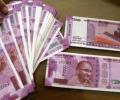
"Cash is still quite high in the system. There is also stocking of Rs 2,000 notes in evidence. The expansion of digital payments is taking place all over the world. It is happening in India as well. The pace is much slower," S C Garg, who took VRS from government service after he was abruptly shifted out of the finance ministry, said in a note.
The rupee had surged 37 paise to end at a nine-month high of 59.68 against the dollar on Tuesday. Forex market remained closed on Wednesday for 'Buddha Purnima'.

"A very easy solution to suggest is tax-payers must pay because the private sector has defaulted," Jaitley said, adding that bank recapitalisation, where the government puts in more capital in public sector banks to shore up their books, effectively amounted to that. "Therefore, I think let's try and make the private sector pay for their debts or allow somebody else to step in."

The ever-astute Ravi Matthai, Director of Indian Institute of Management, Ahmedabad in 1971, offered me a basic salary of Rs 1,000 per month on my return from the United States. I doubt if IIMA could hire a faculty member at Rs 55,000 per month today! points out Dr Shreekant Sambrani.

Assocham expressed concern over the precarious situation that the manufacturing sector is in, observing that if the trend does not reverse with monetary and fiscal measures it would be difficult for the industry to generate jobs.
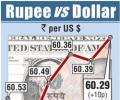
Forex dealers said besides increased selling of the American currency by exporters and banks, a higher opening in the domestic equity market and the dollar's weakness against other currencies overseas supported the rupee.

State-owned banks have amassed bad loans faster than private sector lenders.
The dollar's gains against other currencies overseas and a lower opening in the domestic equity market also put pressure on the local unit, forex dealers said.

'For years, the RBI has been warning banks on probable frauds in bank guarantees and advised them to exercise due care.' 'PSB staffers feel their jobs are secured, hence there is no need to be vigilant and exercise financial prudence.'

Karvy group's commodity broking arm, too, is facing a liquidity crisis because of some issues related to NCDEX, said people in the know.

The partially convertible rupee closed at 61.45/46 per dollar, weaker from Wednesday's 61.35/36.
RBI will be cautious easing rates further given oil price uncertainties
.jpg)
The rupee resumed slightly lower at 62.05 per dollar as against the last weekend's level of 62.04 at the Interbank Foreign Exchange market. It recovered to 61.88 per dollar before quoting 61.93 at 1045 hours.

Last year this time, India was grappling with an imminent sovereign downgrade, with an uncontrolled fiscal deficit, policy paralysis of the highest order with no economic reforms for eight long years and a weakening rupee.

Dollar's strength and falling crude oil prices force downward revision of 2015 growth forecast.
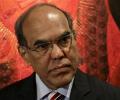
Subbarao said, short-term as well as medium-term prospects or Indian economy continue to be grim. Fiscal deficit is going to be much higher, the debt burden much larger and the financial sector will be in a worse shape.

A series of steps taken by the government to promote ease of doing business and liberalisation of foreign direct investment norms have helped India receive record FDI inflows so far this year, and implementation of measures like PM Gati Shakti, single window clearance and GIS-mapped land bank are expected to further push investments in 2022. Notwithstanding the global slowdown and the COVID-19 pandemic, total foreign direct investments into India rose to a record $81.72 billion in 2020-21. During April-July this fiscal, FDI (foreign direct investment) into the country increased by 62 per cent to $27.37 billion.

Use this window to lock into bank FDs; unless govt cuts small savings rates, banks may not cut deposit rates

No government can 'ignore inclusiveness in a democracy', Montek Singh Ahluwalia tells Anjuli Bhargava.

Bombay High Court upholds rejection of Shagun Gogia as board member, terms two director appointments invalid.
.jpg)
The partially convertible rupee closed at 63.37/38 per dollar compared with 62.83/84 on Monday. The unit dropped 0.85 per cent on the day, its biggest single-day fall in two weeks.

Stressing that economic growth will only move upwards, the Reserve Bank of India Governor Shaktikanta Das on Friday pegged the GDP growth rate for the next financial year at 10.5 per cent, though a tad lower than the government's projection of 11 per cent. The projection is in line with the estimates in the Union Budget 2021-22 presented in Parliament earlier this week. The Economic Survey, tabled by the government in Parliament recently, has projected that the economy will grow at 11 per cent, up from an estimated historic decline of 7.7 per cent in 2020-21, on account of the COVID-19 pandemic.

RBI's tricky strategy to ease market's pre-Fed jitters.
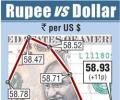
Traders will continue to focus on the measures new Prime Minister Narendra Modi-led government will take to bring down the fiscal deficit and fight inflation.
India imports 1.2 billion barrels of oil, and oil prices are falling, falling...
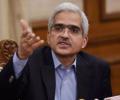
With NEFT, which drives the retail payments value, operationalised on a 24x7x365 basis, the country's payment systems landscape is headed for substantial growth.
 © 2026 Rediff.com - Advertise with us - Disclaimer - Privacy Policy - Sitemap - Feedback - About us - Terms of use - Grievances